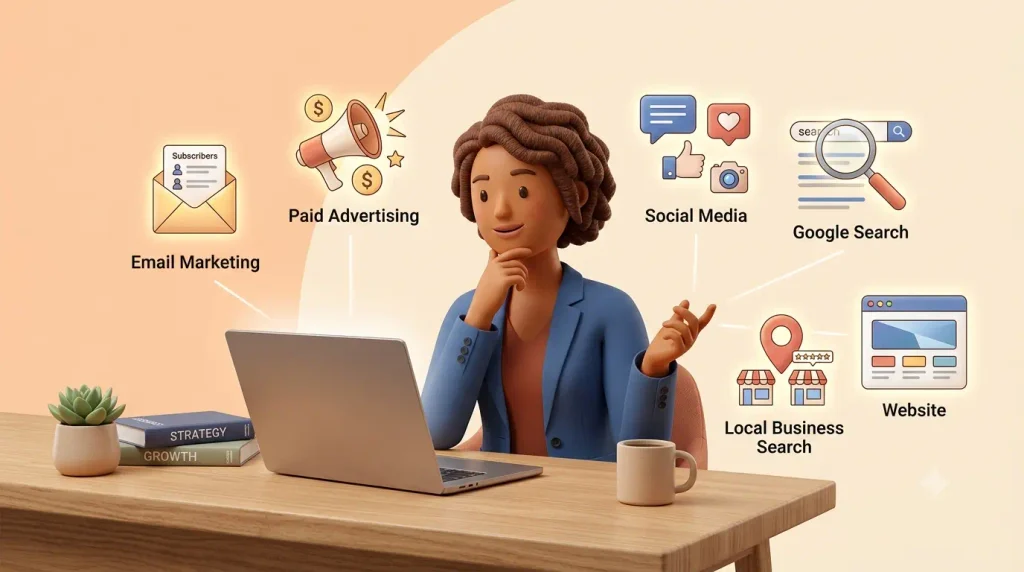
A small business can have a website, an Instagram account, a Google Business Profile, a half-used email list, and a monthly ad budget, yet still have no marketing plan. Often, each piece exists because someone recommended it or because a competitor has one. As a result, none of these activities is tied to a specific outcome, and nobody can say whether they are working. Having several marketing activities is not the same as having a plan. A digital marketing plan for small business connects one business goal to a defined audience, a few chosen channels, the content that supports them, a realistic budget, a way of measuring results, and a regular review.
This guide covers the planning decisions that come first: setting a goal, defining your audience, and choosing your channels. A companion guide, covers what comes next: content, budget, discoverability, measurement, and review. Together they make up a seven-step process for a plan that fits on a single page and covers the next 90 days. Each guide also works on its own. However, both are written for small business owners and solo founders who know their business well but are unsure how to turn digital marketing into something manageable.
-> How to execute a 90-day digital marketing plan for a small business
What Is a Digital Marketing Plan for a Small Business?
A digital marketing plan is a short set of written decisions. It states what you want to achieve, who you are trying to reach, which channels you will use, what you will publish, what time and budget you can commit, how you will measure it, and when you will review it.
It is different from a list of platforms. “We should be on Instagram, start a newsletter, and try Google Ads” is a list. This is a plan:
We want 10 qualified consultation requests per month from local homeowners. Then we will use search and email, supported by three service pages and one helpful guide per month. We will spend two hours a week on it and review the numbers monthly.
The plan tells you what to do this week and how to judge the result in three months.
A useful plan links these elements in order:
Goal → Audience → Channels → Content and assets → Budget and capacity → Discoverability and distribution → Measurement and review
Each element limits the next. Your goal shapes who you target, your audience shapes the channels, your channels determine what you need to create, your capacity decides how much of it you can actually do. This guide covers the first three elements. The later ones are covered in the companion guide on executing the plan.
A small business does not need a 30-page document. If the plan fits on one page and you can explain it in two minutes, it is detailed enough.
Why 90 Days Is a Useful Planning Window
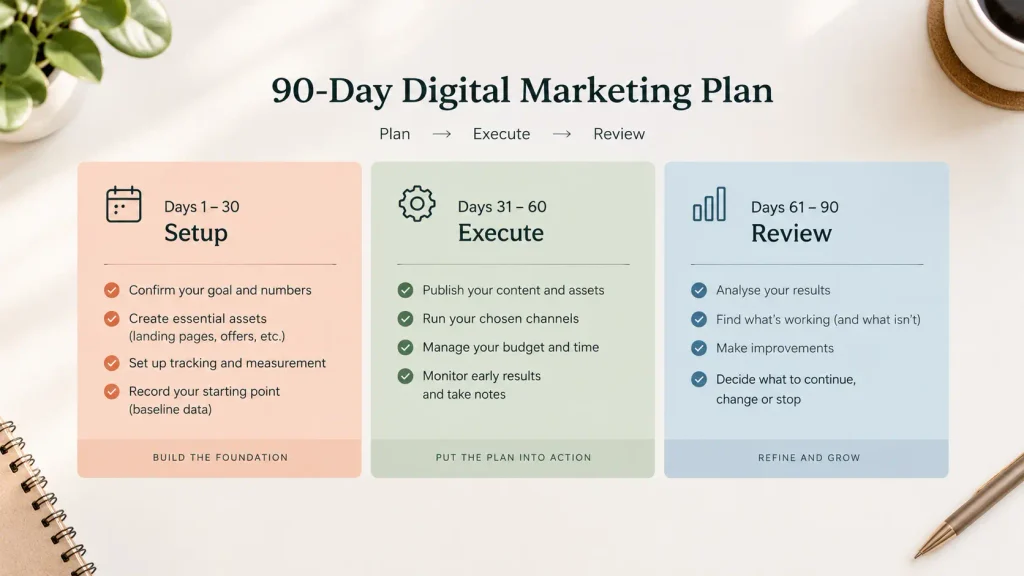
Ninety days is a practical planning window, not a magic number. It gives you enough time to set up the essentials, carry out the plan consistently, collect baseline data, and review early results before deciding what deserves more investment. A year is often too long to stay disciplined without checking in.
The first 90 days are not necessarily about a large business transformation. They are about:
- Establishing a focused system
- Testing whether your chosen channels and activities reach the right audience
- Collecting baseline data
- Identifying which activities bring in qualified enquiries, bookings, or orders
- Improving the plan based on actual results
A rough way to divide the period:
- Days 1–30: Setup and baseline. Clarify your goal, create the essential assets, and record where you are starting from.
- Days 31–60: Consistent execution and observation. Carry out the plan, watch how people respond, and note early patterns.
- Days 61–90: Review and refinement. Refine the approach, drop weak activities, and strengthen what is bringing in qualified enquiries or orders.
This is a planning framework, not a rule or a guarantee of results. Activities also differ in how quickly they provide feedback. For example, paid campaigns can produce early data on clicks, enquiries, or orders. In contrast, SEO and other content-led work may take longer to show results. Similarly, a restaurant promoting a seasonal menu may see results faster than a consultant building a search presence. Therefore, your timeline should reflect your business and marketing approach. If an activity has not had enough time to show results by day 90, use the review to decide whether to continue it rather than automatically assuming it has failed.
Why Most Small-Business Marketing Plans Fail
Most plans fail because they cannot be executed, not because the ideas are bad. These are the usual causes:
- Trying to do everything at once. One person cannot run a blog, three social accounts, a newsletter, and paid ads well. Something gets dropped, usually without a decision.
- Choosing too many channels. Every added channel divides the same limited time and attention, so few get enough consistency to produce a result.
- Creating content without a business objective. Posts and articles that do not point toward an enquiry, booking, sale, or subscription may attract attention but rarely produce anything the business can use.
- Setting unrealistic publishing schedules. “Post daily” works for about two weeks. Then the schedule collapses and the owner feels like the plan failed.
- Spending before the basics are ready. Money spent on traffic cannot compensate for an unclear offer or a page that does not convert.
- Tracking vanity metrics. Follower counts and likes are easy to see. They tell you much less than enquiries, bookings, or revenue.
- Never reviewing or changing the plan. Without a review, you keep repeating what is not working and abandon what was just getting started.
A smaller plan that is actually carried out is more useful than an ambitious plan that cannot be maintained. The steps that follow are built around that idea.
Step 1: Set a Clear Small Business Marketing Goal
Start with a business outcome, not a platform. “We need to be on LinkedIn” is a decision about a tool. “We need more consultation calls” is a decision about the business.
Examples of goals a small business might choose:
- Generate qualified enquiries
- Increase online orders
- Fill appointment slots
- Book consultation calls
- Increase repeat purchases
- Build a relevant email list
Pick one primary goal for the 90 days. A plan with five equal goals effectively has none.
Goal, Objective, and Activity Are Different Things
These three get mixed up constantly:
- Business goal: The result the business needs.
- Marketing objective: The measurable marketing result that supports the goal.
- Activity: The work you do to reach the objective.
Here is how they fit together for a small online shop selling handmade candles. The figures are illustrative:
- Business goal: Increase online sales.
- Marketing objective: Increase monthly online orders from 20 to 30 within 90 days.
- Activities: Improve product pages, publish product-focused content, and run a targeted campaign.
Activities describe the work, objectives define the measurable result, and the business goal explains why that result matters. “Post three times a week” is an activity. It only becomes useful when it serves an objective you can check.
Turn a Vague Goal Into a Measurable One
Use this pattern: outcome + number + timeframe + starting point.
“Get more customers” becomes: “Increase qualified enquiries from 3 per month to 8 per month by day 90.”
If you do not know your starting point, use the first 30 days to measure it. Treat the target as a working estimate, not a promise. The point is to have something to compare against when you review.
Step 2: Define Who You Are Trying to Reach
You do not need a detailed buyer persona. You need a clear enough picture that your content, offers, and channels make sense. Answer these questions in plain language:
- Who is the person you most want as a customer? Be specific about location, type of business, or situation.
- What problem are they trying to solve when they start looking?
- What event usually triggers the search? (A broken boiler, a new baby, a tax deadline, a failed website redesign.)
- What do they need to know before they contact or buy? (Price range, process, proof, timelines.)
- What objections hold them back?
- Where do they currently look for businesses like yours? (Google searches, Instagram, referrals, marketplaces, WhatsApp groups.)
A bookkeeper might write: “Freelancers and small agencies who have fallen behind on records and are worried about an upcoming tax filing. They search for help when a deadline gets close and want to know the cost and what documents to prepare.”
That description tells you what pages to build, what questions to answer, and when demand is likely to rise. If you cannot answer these questions, ask your last five customers. Their answers are more reliable than assumptions.
Step 3: Choose Your Digital Marketing Channels
Now the plan needs a small set of channels that support the goal and the audience. Each channel should have a job in the customer’s journey. Choose a channel because it does something useful for that journey, not because everyone else is using it.
Common Digital Marketing Channels and Their Roles
Here are some possible roles for common channels:
| Channel | Possible role |
| Google Search | Help people discover relevant pages when searching for products, services, or answers |
| Google Business Profile | Support local discovery and provide business information through Google Search and Maps, where applicable |
| Website | Provide detailed information and convert visitors |
| Product or service discovery and visual proof | |
| Nurture existing prospects and customers | |
| Professional visibility and B2B relationships | |
| YouTube | Demonstrate expertise or explain products and services |
Choose Channels Based on Your Business and Audience
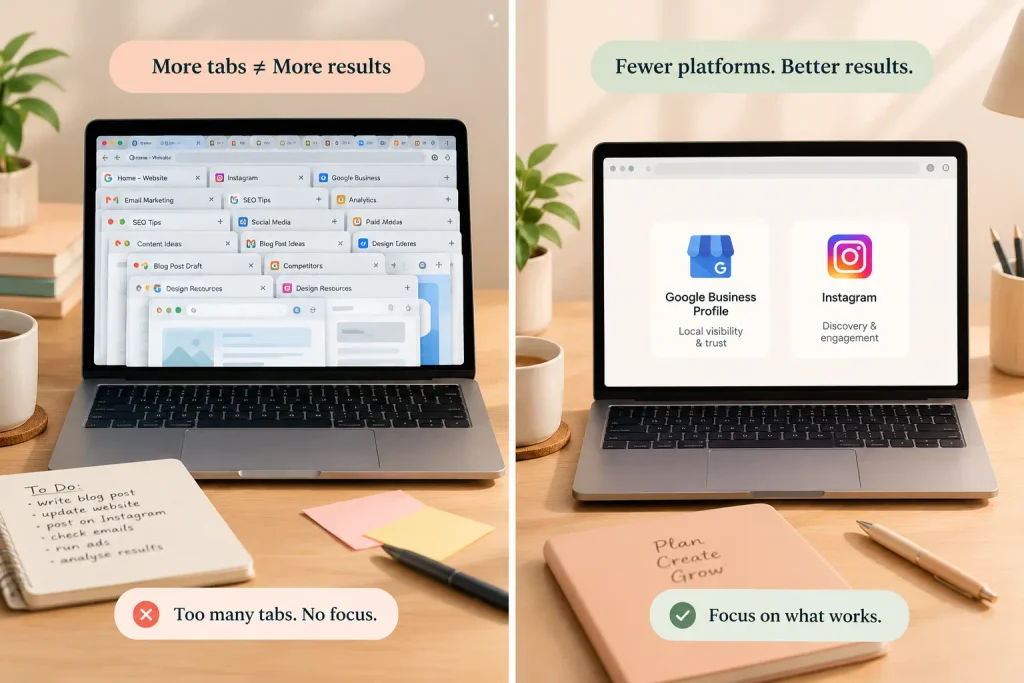
Not every business needs every channel, and plenty need only a few. Which ones fit depends on where your audience looks, how customers make decisions, the time and budget you have, how much content you can produce, and the role you expect the channel to play.
Two businesses with the same goal can end up with very different mixes. A local boutique that wants more online orders might prioritise Instagram, where customers discover products visually, and an ecommerce website where they can buy. A local home renovation contractor that wants more quote requests might skip Instagram as a priority and focus on Google Search, a complete Google Business Profile, and a website with project pages, because homeowners search for a contractor when they need one.
When Should a Small Business Use Paid Advertising?
Paid advertising can sit alongside any of these, including early in a business’s marketing. But if you start paying for traffic before you have validated your offer and conversion process, it becomes difficult to tell whether poor results come from a weak campaign, an unclear offer, or a poorly performing landing page. Paid advertising tends to work when the business has a clear offer, a suitable audience, a functioning landing or product page, a way to handle enquiries or purchases, basic measurement, and a test budget it can afford. You do not need to exhaust organic marketing first, but advertising cannot compensate for an unclear offer, a weak landing page, or a missing conversion process. It simply sends more people to the same problem.
On the number of channels: two or three can be a practical starting point for many small businesses, especially when the owner has limited time or resources. The right number depends on the business, its customers, the buying journey, and whether you can maintain each channel consistently. The principle is focus and capacity, not an arbitrary count.
If you are still deciding which channels deserve a place in your plan, this guide covers the decision in more detail.
-> Choosing digital marketing channels for a small business
Frequently Asked Questions
1. What should a digital marketing plan for a small business include?
A digital marketing plan for a small business should include a clear goal, a defined target audience, suitable marketing channels, a realistic budget, planned activities, measurable KPIs, and a review schedule. It should also record your starting point so you can measure change, and state what you will stop doing if something is not working. All of this can fit on one page. This guide covers the goal, audience, and channels. The companion guide covers the rest.
2. How many digital marketing channels should a small business use?
There is no fixed number. Two or three channels can be a practical starting point for many small businesses, especially when time and budget are limited. The right number depends on where your customers look, how they make buying decisions, and whether you can maintain each channel consistently. A local contractor might do well with Google Search, a Google Business Profile, and a website, while a boutique might add Instagram. Focus and capacity matter more than the count.
From Planning Decisions to an Execution Plan
By this point you should be able to write down three decisions: one primary goal with a number and a timeframe, a clear description of the people you want to reach, and a short list of channels that each have a job. Together with a balanced view of when paid advertising makes sense, those decisions are the strategic core of your plan.
What they do not yet tell you is how the work gets done. The next stage is turning those decisions into an execution plan: the content and assets you need, the time and budget you can commit, how people will find what you publish, and how you will measure and review the results. That is covered in how to execute a 90-day digital marketing plan for a small business, which ends with a one-page template you can fill in.