
A goal, an audience, and a short list of channels are decisions. They only become marketing when someone writes the page, sends the email, approves the budget, and checks what happened. This guide focuses on that second half of the process: turning your marketing decisions into a realistic 90-day digital marketing plan for small business. It covers the content and assets you need, how to set time and budget limits you can keep, how to help people find what you publish, and how to measure and review the results. Whether you are in the setup, execution, or review phase of your 90 days, the work below applies. The guide ends with a one-page template, a worked example, and a starter checklist.
It assumes you already have three things: one primary goal with a number and a timeframe, a clear picture of the people you want to reach, and a short list of channels that each have a job. If you do not know, my previous blog walks through those decisions first. The steps here are numbered 4 to 7 because they continue the same seven-step framework.
-> How to Make a Digital Marketing Plan for Small Business
Step 4: Decide What Content and Assets You Need
A channel is not a plan by itself. Choosing “email” or “Instagram” tells you where, not what. For each channel you selected, work out:
- What content it needs
- What landing pages or service pages are required
- What offers you need to create
- What images, video, or design assets are needed
- What call to action each piece will carry
- Who will create it
- How often you can realistically produce it
Build a Simple Content System
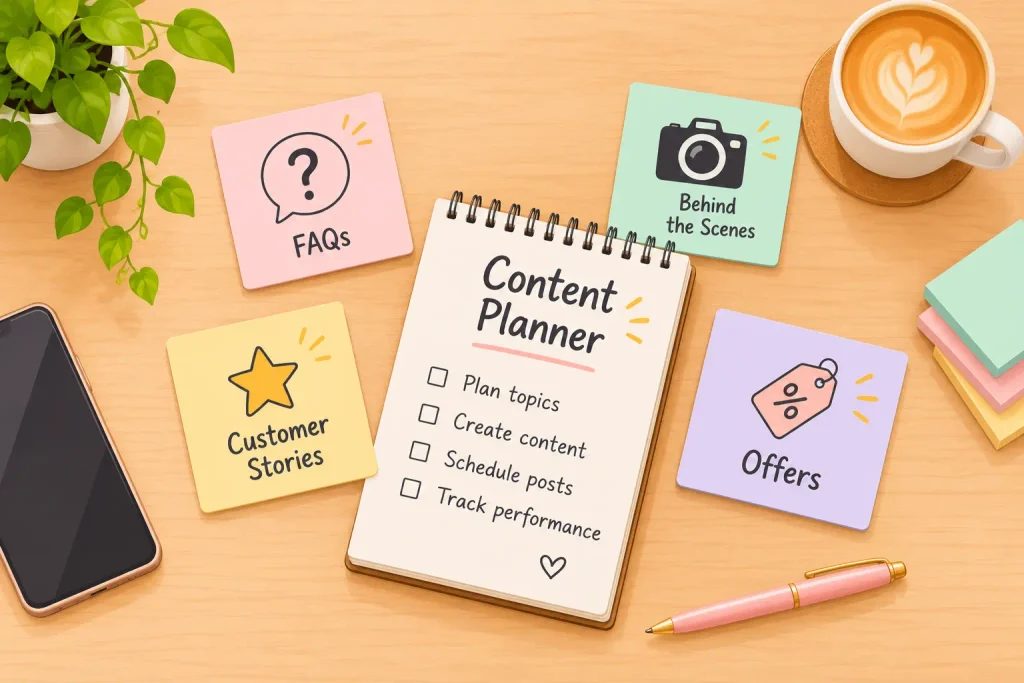
The question “What should I post today?” is a sign there is no system. Instead, define a handful of repeatable content types and rotate through them. Good options for small businesses include:
- Educational content that answers common questions
- Explanations of your products or services
- FAQs drawn from real customer questions
- Case studies or customer stories
- Demonstrations or behind-the-scenes process
- Comparisons that help people choose
- Content that addresses customer objections directly
- Offers and promotions
A local physiotherapy clinic might rotate between an explanation of a treatment, an answer to a common patient question, a short exercise demonstration, and an appointment reminder. That is four content types and enough variety for months.
Be honest about who makes each piece. If the owner writes, photographs, and edits everything, the system must be light. This is where AI-assisted tools can help a small team with outlines, first drafts, or repurposing, provided someone with real knowledge of the business reviews the result. For a practical approach to producing useful content consistently with limited resources, see this guide on
-> AI content SEO – How to Create Content that Ranks on Google
Whatever you create, make sure each piece points somewhere. A guide with no next step is a missed opportunity.
Step 5: Set Your Capacity and Budget Realistically
Plans usually fail on time before they fail on money. Account for both.
Money may include:
- Advertising budget
- Website hosting and tools
- Email software
- Content creation
- Design or video
- Freelancers or agencies
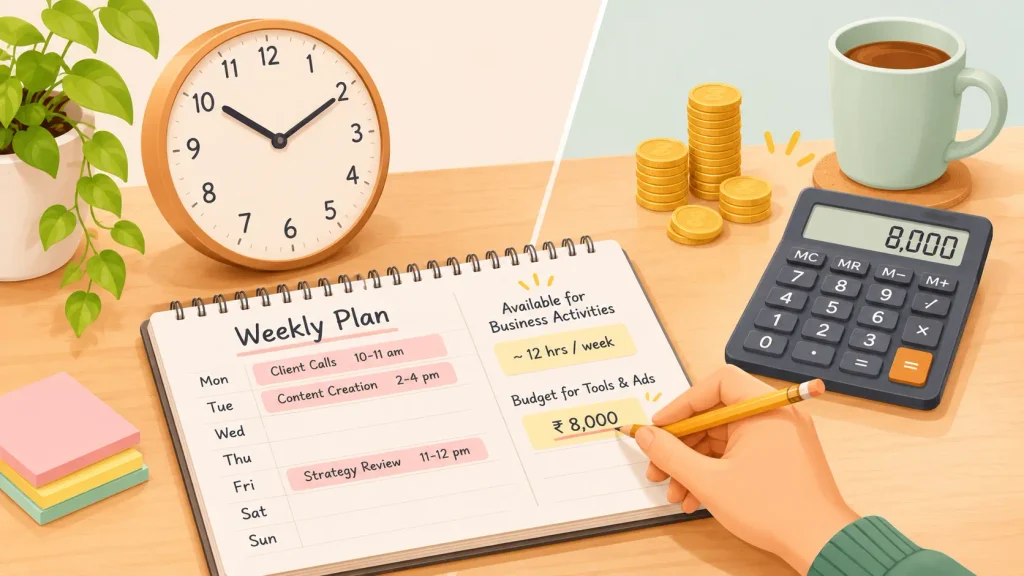
Time means the hours the owner or team can actually give each week, after delivering the work customers are paying for.
Separate two questions: What would be ideal? and What can this business consistently execute? Ideal might be weekly videos, a monthly newsletter, and daily posts. Consistent might be one useful page or post every two weeks and one email a month. The second version wins because it gets done.
As an illustration only, an owner with four hours a week for marketing might spend two on content creation, one on distribution and replies, and one on reviewing results. A business with more budget than time might outsource production but keep approval and review in-house.
If a channel has no realistic time or budget behind it, leave it out of this 90-day plan. You can add it later. Dropping a channel deliberately is better than letting it decay silently.
Step 6: Make Your Content Discoverable
Publishing something does not mean people will find it. Discoverability is the work of getting useful information in front of the right people, and what it involves depends on your business.
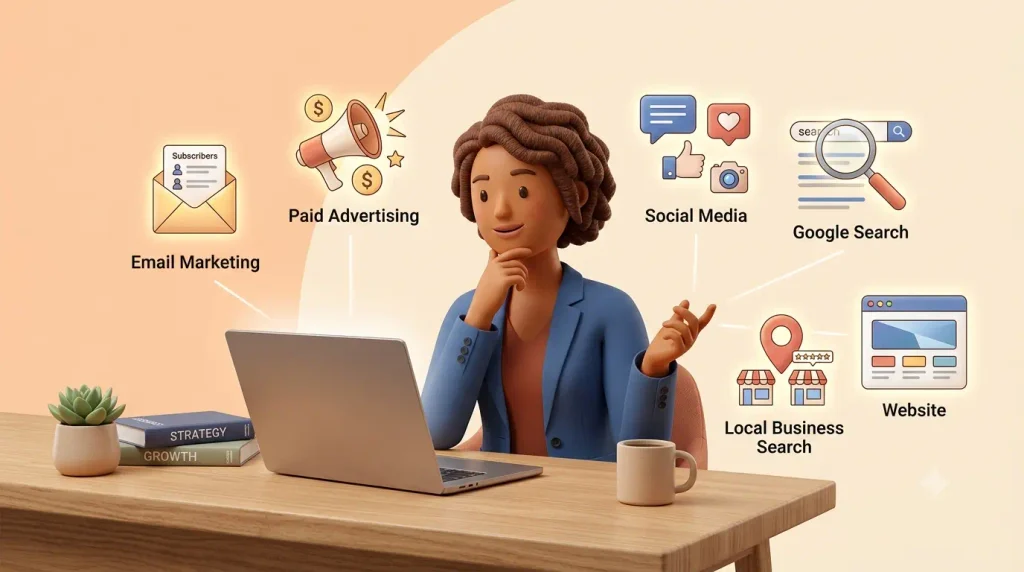
Depending on your channels, it can include:
- Search visibility: Pages that match what people search for, with clear titles and headings.
- Website structure: A logical layout where important pages are easy to reach.
- Useful, relevant content: Pages that answer real questions better than a thin page would.
- Internal linking: Connecting related pages so visitors and search engines can follow them.
- Social distribution: Sharing content where your audience already spends time.
- Email distribution: Sending new content to people who have asked to hear from you.
- Local visibility: A complete Google Business Profile, accurate listings, and reviews, where location matters.
- Clear business information: Explain what you offer, who you serve, where you operate, and how customers can contact or buy from you.
Making content discoverable is one part of the process. The other is ensuring that each channel supports the next step in the customer’s journey. This guide explains how search, websites, social media and email can work together rather than operate as separate marketing activities.
-> Building a connected marketing strategy for your small business
AI-powered search is one emerging place where people now get answers, and it is worth considering as part of this list. It does not need to dominate your plan, and no approach guarantees visibility. Clear, accurate, well-structured content can support visibility in traditional search and AI-powered search, although neither is guaranteed.
If you want to go deeper, my blog explains the specifics.
-> How to optimize content for AI search
For most small businesses, the first priority is simpler: make sure the people already looking for you can find a clear page that answers their question.
Step 7: Set a Review Rhythm and Choose Meaningful Metrics
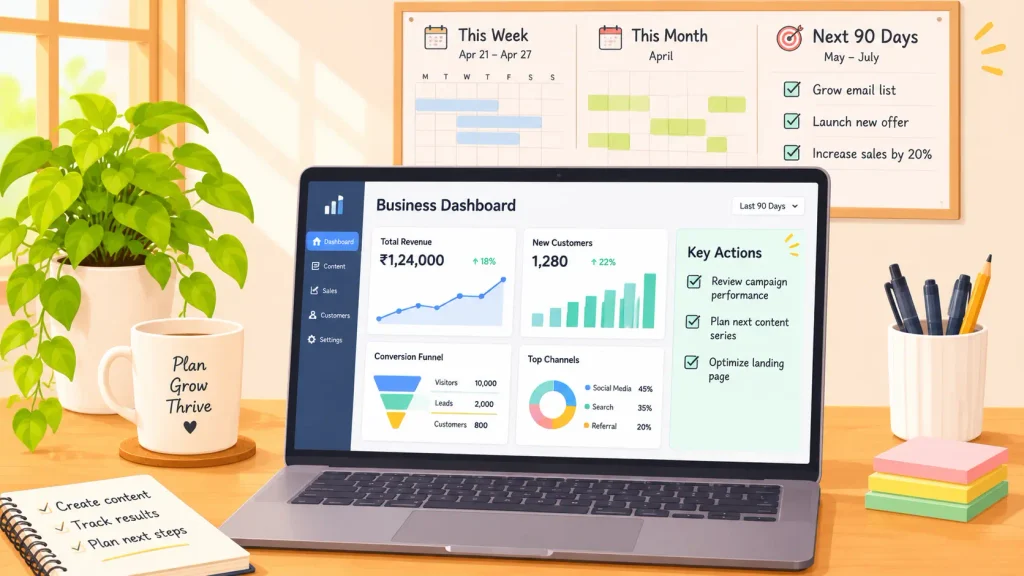
Without a review cycle, a plan is a one-time document. A practical rhythm looks like this:
- Weekly: A short execution check. Did we do what we planned? What blocked us?
- Monthly: A performance review. What did the numbers show? What should change?
- Around 90 days: A larger strategic review. What earned more investment? What should stop?
Timing can vary. Paid campaigns may need closer attention, while search-driven work may need longer before a pattern appears.
Choose Metrics That Match the Goal
Choose metrics you can measure reliably with the data available to you. If you cannot yet track a metric accurately, establish the necessary tracking before using it to judge performance.
You do not need to track everything. Pick a few measures connected to your goal.
If the goal is enquiries:
- Qualified leads
- Enquiry conversion rate
- Cost per qualified lead
If the goal is sales:
- Orders
- Conversion rate
- Revenue
- Customer acquisition cost, where you can measure it
Whether the goal is visibility:
- Relevant search impressions
- Qualified website traffic
- Engagement with useful content
Follower counts, impressions, and likes can be informative, but they should not be your primary measure unless they connect to a business result. A home renovation contractor might get plenty of views on project photos, but the numbers that matter are quote requests and how many of those become paid jobs.
One-Page Digital Marketing Plan Template
Use this as a small business marketing plan template. Copy it into a document or notebook and fill in each line. Short answers are fine, and you do not need marketing expertise to complete it.
- Business goal:
- Marketing objective:
- Target audience and main problem:
- Starting point / baseline (where you are today):
- Priority channels:
- Role of each channel:
- Content and activity plan (what, how often, who):
- Monthly budget and weekly time:
- Conversion path (how a visitor becomes an enquiry or sale):
- KPIs / measurement:
- 90-day target:
- Review dates (weekly, monthly, day 90):
- What we will stop doing if it is not working:
Example: A Local Bookkeeping Practice
- Business goal: Increase qualified consultation requests from freelancers and small agencies.
- Marketing objective: Increase qualified monthly enquiries from 3 to 8 by day 90.
- Target audience and main problem: Freelancers behind on records and worried about an upcoming tax filing.
- Starting point / baseline: 3 qualified enquiries a month, mostly from referrals. Website-generated enquiries are not yet tracked separately.
- Priority channels: Website with search, Google Business Profile, and a monthly email to the practice’s existing permission-based list of past clients and prospects who have asked to hear from it.
- Role of each channel: Search reaches people already looking. The profile builds local trust. Email keeps past clients and existing prospects informed and prompts enquiries.
- Content and activity plan: One service page, one pricing explanation, one “what to prepare” guide, a short enquiry form. Two hours a week on content and replies, one hour on follow-up.
- Monthly budget and weekly time: A small fixed amount for tools and design; three hours a week.
- Conversion path: Guide or service page → enquiry form → call.
- KPIs / measurement: Total qualified enquiries, website-generated enquiries, and enquiry-to-client rate.
- 90-day target: Move from 3 to 8 qualified enquiries a month.
- Review dates: Friday check each week, first working day of each month, day 90.
- What we will stop doing: Reduce or pause social posting if it consistently consumes time without meaningful engagement, relevant website visits, or enquiries by day 60. Review its role before deciding whether to stop completely.
The example is deliberately small. A plan this size is more likely to be done.
Starter Checklist
Use this before you start the 90 days. The first few items confirm the planning decisions are in place. The rest check that you can carry them out.
- I have one clear business goal with a number and a timeframe.
- I know who I am trying to reach and what problem they are solving.
- I have recorded my starting point so I can measure change.
- I have chosen only the channels I can realistically maintain.
- I know what content and assets each channel needs.
- I have set a realistic budget and weekly time commitment.
- There is a clear path from content or channel to an enquiry, booking, or sale.
- I know which few metrics matter and where to find them.
- I have scheduled weekly, monthly, and 90-day reviews.
- I know what I will test and what I will stop if it is not working.
Frequently Asked Questions
- How do I create a 90-day marketing plan?
Start by choosing one business goal and writing down your current baseline, such as monthly enquiries or online orders. Then define your audience, select the channels you can realistically maintain, and list the content and assets each one needs. Use days 1 to 30 for setup and baseline activity, days 31 to 60 for consistent execution and observation, and days 61 to 90 for review and refinement. Schedule weekly and monthly check-ins so the plan gets adjusted along the way. Treat the 90 days as a planning framework, not a guarantee of results.
- How much should a small business spend on digital marketing?
The right amount depends on your goal, your margins, your capacity, and what you can afford to test without strain. Rather than starting from a universal percentage, work out what a new customer or enquiry is worth to your business, decide how much you can invest while you learn what works, and set a fixed monthly limit. Remember that time is also a cost. A channel with no realistic budget or hours behind it should be left out of the plan until you can support it.
- How often should I review my digital marketing plan?
A simple rhythm works for most small businesses: a short weekly check on whether you did what you planned, a monthly review of the numbers and what to change, and a larger strategic review at around 90 days. The timing can vary. Paid campaigns may need closer attention, while search-driven work often takes longer to show a pattern. At each review, decide what to continue, what to change, and what to stop.
Putting the Plan Into Practice
A 90-day plan works when it is small enough to carry out: content you can actually produce, a budget and schedule you can sustain, and a review rhythm you keep. Fill in the one-page template, schedule your first weekly check, and begin. By day 90, you should have a clear basis for deciding what to continue, what to change, and what to stop.
If you cannot complete the template because your goal, audience, or channels are still unclear, go back to
-> How to Make a Digital Marketing Plan for Small Business
Make those decisions first, then return here to put the plan to work.
About the Author
Harshita Gadodia is a Digital Marketing Blogger and WordPress Developer based in Kolkata. Her work focuses on WordPress website development, SEO, content creation, analytics, and practical digital marketing strategies.
She publishes actionable guides that simplify digital marketing concepts and explore how businesses can improve their websites, reach relevant audiences, and measure their online performance.
In this article, she explores how small businesses can turn their marketing strategy into a practical 90-day execution plan through content planning, realistic budgeting, improved discoverability, and performance measurement.
Connect with Harshita Gadodia on LinkedIn for the latest articles, website projects, and digital marketing insights.

Pingback: How to Build a Digital Marketing Plan for a Small Business